Canada guide
RRSP vs TFSA: Which Should You Max First in 2026?
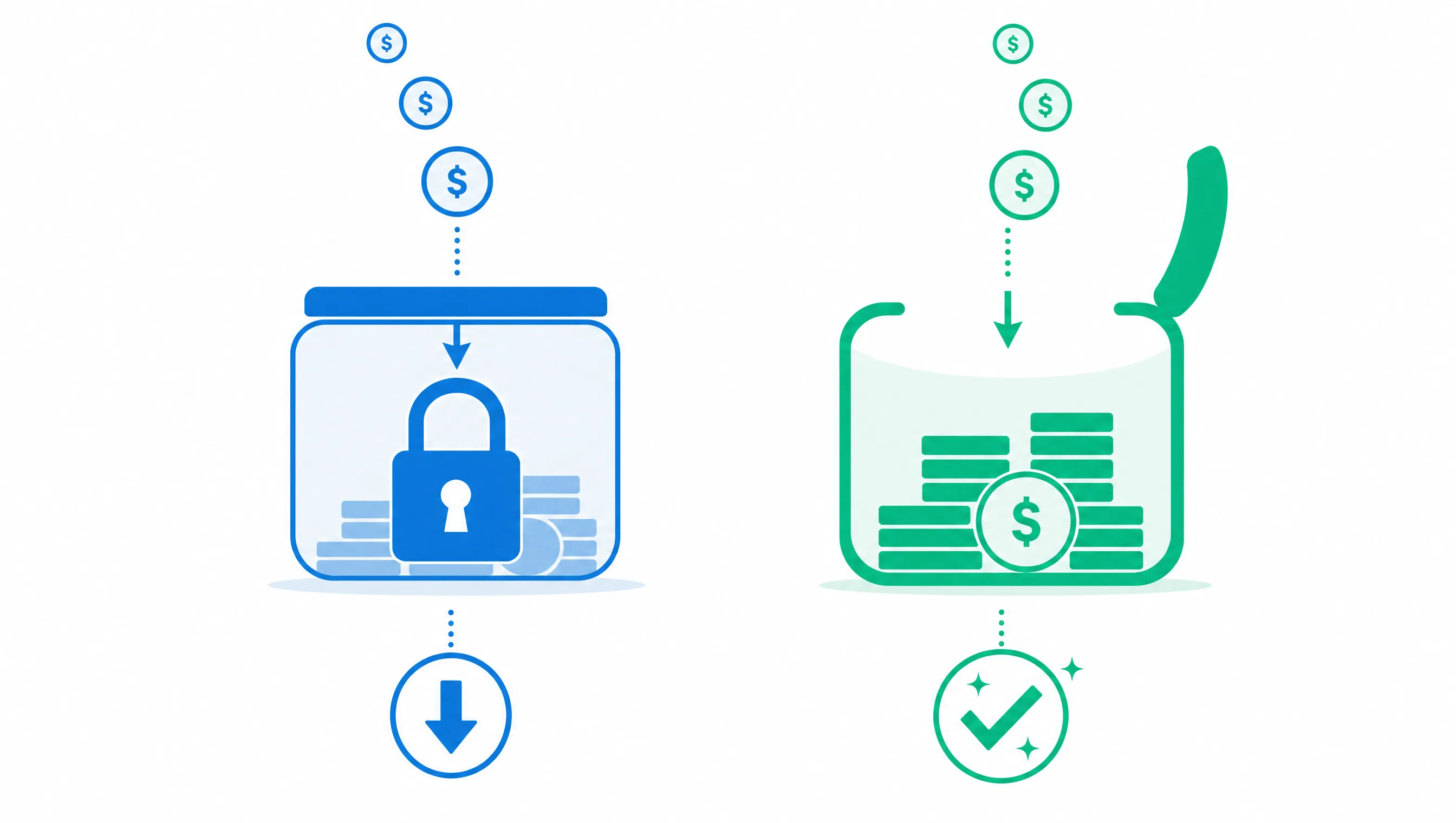
The Registered Retirement Savings Plan and the Tax-Free Savings Account are the two accounts most Canadians use to shelter investments. The CRA designed them as mirror images: an RRSP deducts contributions today and taxes withdrawals later, while a TFSA uses post-tax money today and gives tax-free withdrawals later. This guide covers the 2026 limits, the cases where each wins, and where the new First Home Savings Account fits.
Side-by-side comparison
| Feature | RRSP | TFSA |
|---|---|---|
| Contribution tax | Deductible from taxable income | Post-tax, no deduction |
| Growth tax | Tax-deferred | Tax-free |
| Withdrawal tax | Taxed as ordinary income | Tax-free |
| 2026 contribution limit | 18% of prior-year earned income, capped at $33,810 | $7,000 ($109,000 cumulative if eligible since 2009) |
| Unused room carries forward | Yes, indefinitely | Yes, indefinitely |
| Withdrawals restore room | No | Yes, in the following calendar year |
| Mandatory conversion | RRIF by end of year you turn 71 | None |
| Counts toward OAS clawback | Yes, withdrawals are income | No |
RRSP in detail
An RRSP contribution reduces your taxable income for the year. The CRA sets the 2026 deduction limit at 18% of your 2025 earned income, capped at $33,810. Your actual room is on your most recent Notice of Assessment and includes any unused room carried forward from previous years.
You also have a small over-contribution buffer of $2,000 before the CRA charges a 1% per month penalty. Contributions made in the first 60 days of 2027 can be deducted on your 2026 return.
Withdrawals are added to your income in the year you take them out and the institution withholds tax up front. Two exceptions let you borrow temporarily: the Home Buyers' Plan allows up to $60,000 toward a first home, and the Lifelong Learning Plan allows $20,000 for education. Both must be repaid on a schedule or the unrepaid amount becomes taxable income.
TFSA in detail
A TFSA holds investments that grow and pay out tax-free. The 2026 annual contribution limit is $7,000. If you have been a Canadian resident and at least 18 since the TFSA launched in 2009 and have never contributed, your cumulative room is $109,000 as of 2026.
The TFSA is the most flexible registered account the CRA offers. Withdrawals are tax-free and add the withdrawn amount back to your contribution room on January 1 of the following year. There is no mandatory conversion at any age, and withdrawals do not count as income for Old Age Security clawback, Guaranteed Income Supplement, or GST credit calculations.
The main trap is re-contributing in the same calendar year as a withdrawal. The CRA charges 1% per month on any over-contribution, and it catches a steady stream of taxpayers every year.
When the RRSP wins
The RRSP wins when your marginal tax rate today is higher than your expected rate in retirement. Deducting at a 43.4% combined federal-provincial rate while drawing later at 24% is a 19-point arbitrage before any growth.
The RRSP also wins on capacity if you earn a high income. Eighteen percent of $175,000 is more than four times the TFSA limit, and it scales with income whereas the TFSA does not. It is the natural home for primary retirement savings once you are in the top two or three federal brackets.
When the TFSA wins
The TFSA wins when your marginal tax rate today is lower than your expected rate in retirement. Anyone earning under roughly $58,000 in 2026 is in or below the lowest combined bracket and gets little value from the RRSP deduction. Putting the same dollars in a TFSA locks in tax-free growth and avoids dragging future government benefits down through OAS clawback.
The TFSA is also the right vehicle for any goal short of retirement. Emergency funds, house deposits, sabbatical funds, and big purchases all benefit from the re-contribution rule and the tax-free withdrawal. The RRSP punishes withdrawals; the TFSA does not.
The FHSA option for first-time buyers
The First Home Savings Account, introduced by the CRA in 2023, blends the best of both accounts for a first home purchase. Contributions are tax-deductible like an RRSP and qualifying withdrawals are tax-free like a TFSA.
The annual contribution limit is $8,000, with a lifetime limit of $40,000. Up to $8,000 of unused room carries forward. The account must be used within 15 years of opening or by the end of the year you turn 71, otherwise the balance has to be moved to an RRSP or RRIF or withdrawn as taxable income.
If you are saving for a first home and have the room, the FHSA should typically be filled before either the RRSP or the TFSA. You can also combine it with the RRSP Home Buyers' Plan on the same purchase.
A reasonable default ordering
- Capture any employer RRSP match in full.
- If saving for a first home, fund the FHSA up to $8,000 per year.
- If your marginal bracket is high, fund the RRSP next. If your bracket is lower than the rate you expect in retirement, fund the TFSA next.
- Use the leftover account once the priority one is full.
See which order fits your numbers
The calculator pulls your federal and provincial brackets, applies the CRA RRSP cap and your TFSA room, and shows the after-tax outcome of putting the next dollar in each account. It also models the FHSA where it applies.
Open the Canada calculator